Succulents: the right plant for everyone who says "I kill all plants"
You know the person. You might be the person. You buy a plant, look at it sideways once, and it dies. You buy another, same story. You decide you don't have a green thumb and you give up.
Succulents are here to change that story.
These plants evolved in deserts and dry mountains where rain falls maybe once a month. They survived conditions that would kill any other plant. Your home, even with no watering for weeks, is nowhere close to that.
The only thing that kills succulents is too much water. And that's easy to fix once you understand why.
Why succulents don't die from neglect
Succulents store water in their leaves, stems, or roots, depending on the type. With that reserve, the plant can go for days, even weeks, without watering.
You can see it visually. When a succulent runs low on water, the leaves start to wrinkle a little or look a bit "softer." That's the signal. Not urgent, but a signal.
Plumper leaves mean more water inside. Thick, firm, juicy leaves mean a well-watered plant. Soft, wrinkled leaves mean it's time to water.
The one thing that kills succulents, and how to avoid it
Too much water. Period.
Succulent roots can't handle constant moisture; they rot fast. Signs of root rot: the plant looks oddly soft, leaves fall off at the lightest touch, and the soil smells sour.
The right way to water:
- Water deeply, all the way to the bottom of the pot
- Wait until the soil is completely dry, to the bottom, not just the surface
- Only then, water again
How long does that take? In summer, 10 to 14 days. In winter, three to four weeks or more. There's no fixed schedule. Watch the soil, not the calendar.
The saucer under the pot:
Empty it right after watering. Water sitting in the saucer means wet roots, which means death.
Soil and pot: that's 50 percent of success
Soil:
Standard plant soil doesn't work. It holds too much moisture. Buy a special succulent and cactus mix, or make your own: standard soil mixed with 50 percent sand or perlite. The soil has to drain fast.
The test: water the plant and watch. The water should run out of the drainage hole in 5 to 10 seconds. If it sits, the soil is wrong.
Pot:
Must have a drainage hole. Without one, you can't water properly. A terracotta pot is ideal because it absorbs extra moisture. For pretty pots without a hole, put the succulent in a smaller liner with a hole, then put the liner inside the pretty pot.
Light: and why succulents on a north window suffer
Succulents love light. Strong, direct sun. A south window is ideal.
In a north-facing or dark spot, succulents stretch toward the light. They get long and leggy and lose their compact shape. The technical term is etiolation. The plain version: the plant "stretches out." It's not dangerous, but the plant loses its nice shape.
If you only have a north window, pick types that handle low light better: haworthia, gasteria, aloe. Most standard succulents won't be happy there.
Moving a plant:
If you move a succulent from a dark spot to strong sun, do it gradually. Straight from shade to direct sun leads to leaf burn (white or brown spots). One to two weeks of indirect light first, then slowly to direct sun.
Popular types, and which ones to pick
For beginners (almost impossible to kill):
Echeveria:
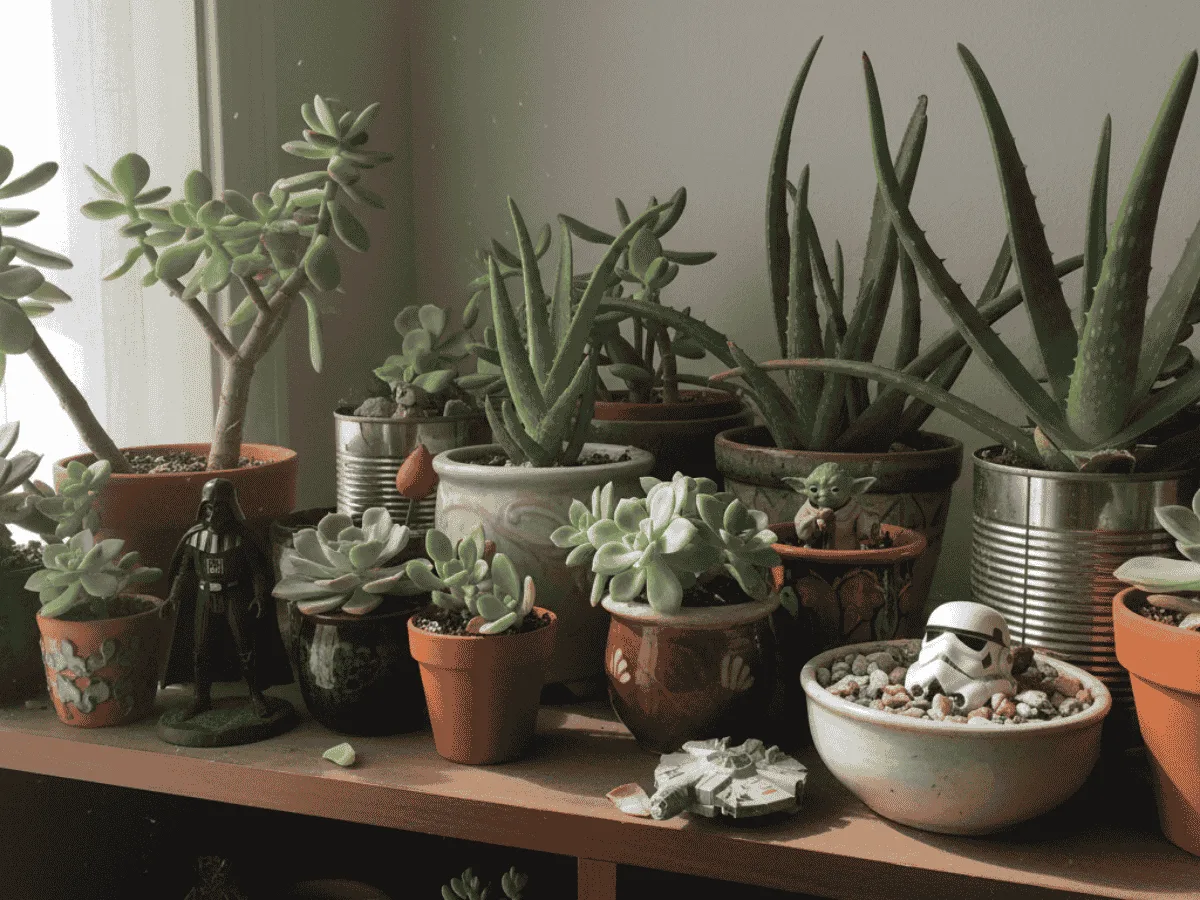
The classic rosette shape, easy to find, comes in dozens of colors. Loves direct sun.
Haworthia:
Small, dark green, handles shade. Ideal for an office or a north window.
Sedum:
Trailing or upright, fast-growing, easy to propagate. Great for bigger pots or high shelves.
Crassula (jade plant):
Tree-like, long-lived, a feng shui classic. Can live for decades.
For people with some experience:
Lithops (living stones):
They look like stones and bloom from inside. Need a strict dry winter to grow well.
Euphorbia:
Many forms, some look like cacti. Note: the milky sap irritates skin and eyes.
Aeonium:
Rosette on a stem, spectacular look. Winter grower, dormant in summer.
Propagation: free new plants
This is one of the things that makes succulents addictive. They propagate easily from leaves and cuttings.
From a leaf:
- Gently break off a healthy leaf, with no bits of stem attached
- Leave it on a piece of paper for two to three days so the cut surface dries
- Place it on a damp succulent mix; don't bury it, just lay it on top
- Put it in a bright spot, mist it lightly once a week
- In two to four weeks, tiny roots and mini rosettes appear
From a cutting:
- Cut off the top or a side shoot with a clean knife
- Leave it for two to three days so the cut dries (this step matters; otherwise it rots)
- Plant it in dry mix, water only after a week
- Hold it upright with a toothpick if it's wobbly
One plant can give you dozens of new ones. Great for gifts.
Succulents in the office
Succulents are ideal for a workspace. No regular watering, they look good, and they don't suffer if you forget them over a long weekend or holiday.
On a desk, a shelf, a reception counter: small succulent pots add character to a space without any commitment.
If you're looking for office greenery with no fuss, talk to us about office plants
FAQ
Why does my succulent have soft, see-through leaves?
Too much water. Remove the damaged leaves, let the soil dry out completely, and cut back on watering.
Why is my succulent turning pink or red?
Stress from sun or cold, and that's a good thing. Anthocyanins (pigments) kick in as protection. The plant is healthy, just "blushing."
Can succulents flower?
Yes. Most flower once a year, usually in spring or summer. The flowers grow on a long stalk from the center of the rosette. Spectacular, but short-lived.
How long do succulents live?
It depends on the type: from a few years to decades. Crassula (jade plant) is famous for lasting through generations.
Can I mix different types in one pot?
Yes, but pick types with similar water and light needs. A mix of echeveria, sedum, and haworthia in one shallow pot looks great.