A plant doesn't forgive a bad spot: a conversation with landscape architect Milan
Milan is the lead landscape architect at Urbigrow. He's been working in landscape architecture for more than 15 years, from terraces and private gardens to green interiors in office complexes. He designs, builds, and maintains. That combination is rare in this field.
We asked him what clients ask us most often: what a landscape architect actually does, which plants survive in an office with little light, and how much it all costs.
What does a landscape architect actually do?
People usually mix up four things. A nursery sells plants. A gardener waters and prunes them. A contractor builds what someone else designed. A landscape architect, to me, is a mix of all of that. They should figure out what goes where and why, but also carry out the whole project from start to finish, then take care of the plants afterward. Stand behind the work and guarantee it will survive.
The problem is that in practice, a landscape architect usually only handles one of those parts. They design it, draw it up, and then you go find a contractor. The contractor builds it however they see fit, and then you go find someone to maintain it. A third person shows up a year later and asks who even planted this. Everyone sees only their own piece, and nobody is responsible for the whole thing.
I do it differently. I design, I build with my own hands and a skilled team, and I maintain the greenery afterward. Not because it's some special philosophy, but because over the years I've learned it's the only way to guarantee the result.
The work breaks down into four phases:
- Analysis and concept. How much light the space gets and where it comes from, humidity levels, drafts, or heating above the pots. Then layout: where a plant makes visual sense and where it actually thrives. Then choosing species, pots, and materials, because a pot isn't just about looks. It decides how far the root system can grow. All of this goes into a spec you can actually build from, not a pretty picture.
- Preparation. Sourcing materials, putting together the build team, organizing the work and transport. Takes anywhere from a few days to a few weeks, depending on the job.
- Build. The fastest part, usually one to three days.
- Maintenance. The part that decides whether everything before it still makes sense a year later.
What people don't see is that this job is half creative, half hands-on trade work. I spend as much time on-site with a tool in hand as I do over a project plan. That taught me more than any book: when you install what you designed yourself, you very quickly stop drawing things that can't actually be built.
Because the skill isn't drawing something that looks great on paper. The skill is making something that still looks great two years later, under real conditions. If you can't build it and then follow through on care, the client paid for something that will fall apart. That's the worst way to spend money.
Which plants survive in a low-light office?
That's the champion of all questions. There's an answer, but first I need to clear something up.
Low light isn't the same as no light. No plant can survive in total darkness. That's not about how tough a species is, it's photosynthesis. When someone tells me "I have a corner with no windows," a plant isn't the answer there. Artificial lighting is, or something else entirely.
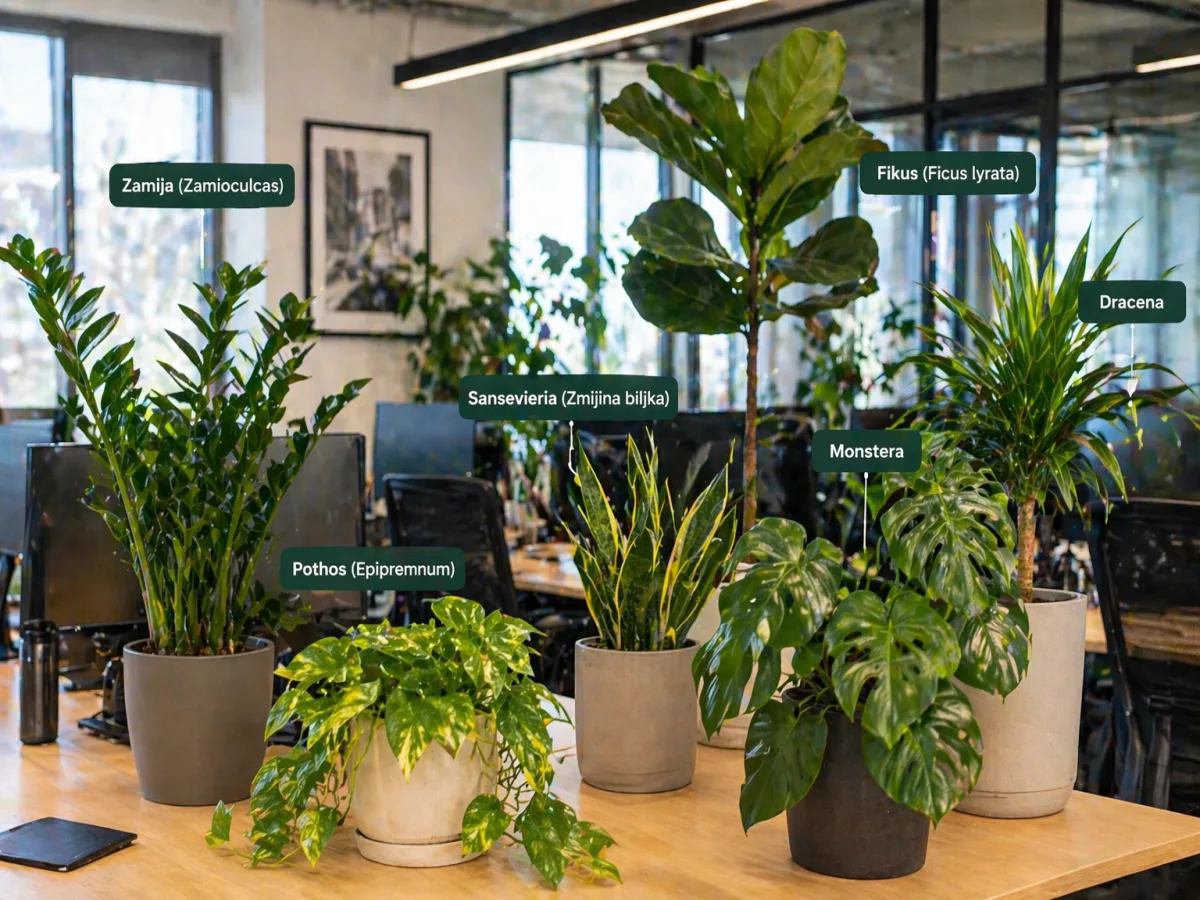
For spaces with weak but present light, Milan picks four plants that hold up best in practice:
- ZZ plant (Zamioculcas): the toughest one I know. Handles neglect, dry spells, and poor light.
- Snake plant (Sansevieria): practically indestructible, and its upright shape "holds" a room visually.
- Certain dracaenas: not all of them, but some varieties do great in partial shade.
- Pothos (Epipremnum): perfect for shelves and tall cabinets. Grows even when you forget it.
Now here's something that will actually help, because it's the number one mistake I see: in low light, water less often, not more. Less light means slower growth, and slower growth means less water use. The soil stays damp for days. People see the plant droop, assume it's thirsty, add more water, and the roots rot. Nine out of ten dead office plants I've come across didn't die from dryness. They died from too much care.
A practical rule: push a finger about an inch into the soil. If it's damp, leave it alone. And turn the pot 90 degrees every couple of weeks, so the plant doesn't grow lopsided toward the window.
What's better: lots of greenery on a budget, or a few large arrangements?
There's no single right answer, and don't trust anyone who says there is.
More smaller plants spread through a space give the feeling that greenery is everywhere, that the space feels "alive." A few large, well-thought-out arrangements make an impact. They're what people remember when they walk in. Both approaches are completely valid. It depends on the space, the budget, and what the client wants to achieve.
My job isn't to push my own taste on a client. My job is to understand what they want and what they have to work with, then get the most out of it within those limits. It's always a joint result, not my monologue.
How much does landscaping cost?
Tough question to answer, but I get why everyone asks it.
The price depends on the project, what the client wants, the size of the space, location, and how feasible it is. Sometimes a client wants a custom-built planter with exotic plants, exact dimensions and rounded corners, which raises the price a lot. Other times a client gives us a rough budget and lets us find the best, most cost-effective solution.
In my experience, a landscaping project can run from €600 to €800 up to €25,000 to €30,000, and even more for larger residential or commercial complexes that include irrigation systems and other extras.
This is just a rough range. We're always glad to get an inquiry so we can see what's possible. One piece of advice: tell us your budget upfront. It's not an awkward question. It's information that tells us where to focus. Without it, we waste both your time and ours.
Is the site visit free?
Yes. The first visit, measuring the space, and the conversation are all free and don't commit you to anything. It takes 30 to 45 minutes.
What you do pay for is the project spec: a detailed presentation with images of the design and a table of all the plants, pots, and materials, ready to build from. That starts at €100 and goes up depending on the size of the project. But that amount gets deducted from the final price once we start the work, so if you go with us, it ends up costing you nothing. The spec stays yours only if you decide to hand the build to someone else, and that's fair.
One last thing
If you remember only one thing from this whole conversation: greenery is an investment, and investments need upkeep. Even the most beautiful project falls apart within three months if the person looking after it isn't doing it as a job. That's why I always recommend clients set up regular maintenance with us, especially for larger projects. It works out cheaper than fixing it later.
Read more about professional plant maintenance and pricing here.
Have a space you'd like to green up?
Email us at info@urbigrow.com. Tell us the type of space, the rough size, and your budget, and we'll see what we can do.